

Lower Your Mortgage Payments: Options Worth Exploring Before You Give Up
 By Ethan Tran | The Tran Team | DRE #02229531
If high mortgage payments are keeping you from buying a home, it may be worth taking a closer look at how the financing is structured.
A seller credit could help reduce your interest rate. A temporary buydown could ease payments during the first few years. And if your finances do not fit a traditional documentation process, an alternative-documentation or Non-QM loan may deserve a conversation with a qualified lender.
For buyers across Los Angeles, the Inland Empire, and Orange County, the useful question is: What options fit your finances, and what does each one actually cost?
A lender recently shared the following purchase scenarios and program examples with me. The buydown illustrations are dated October 16, 2026. They show how different structures affect payments; they are not current rate quotes or proof that a particular loan closed.
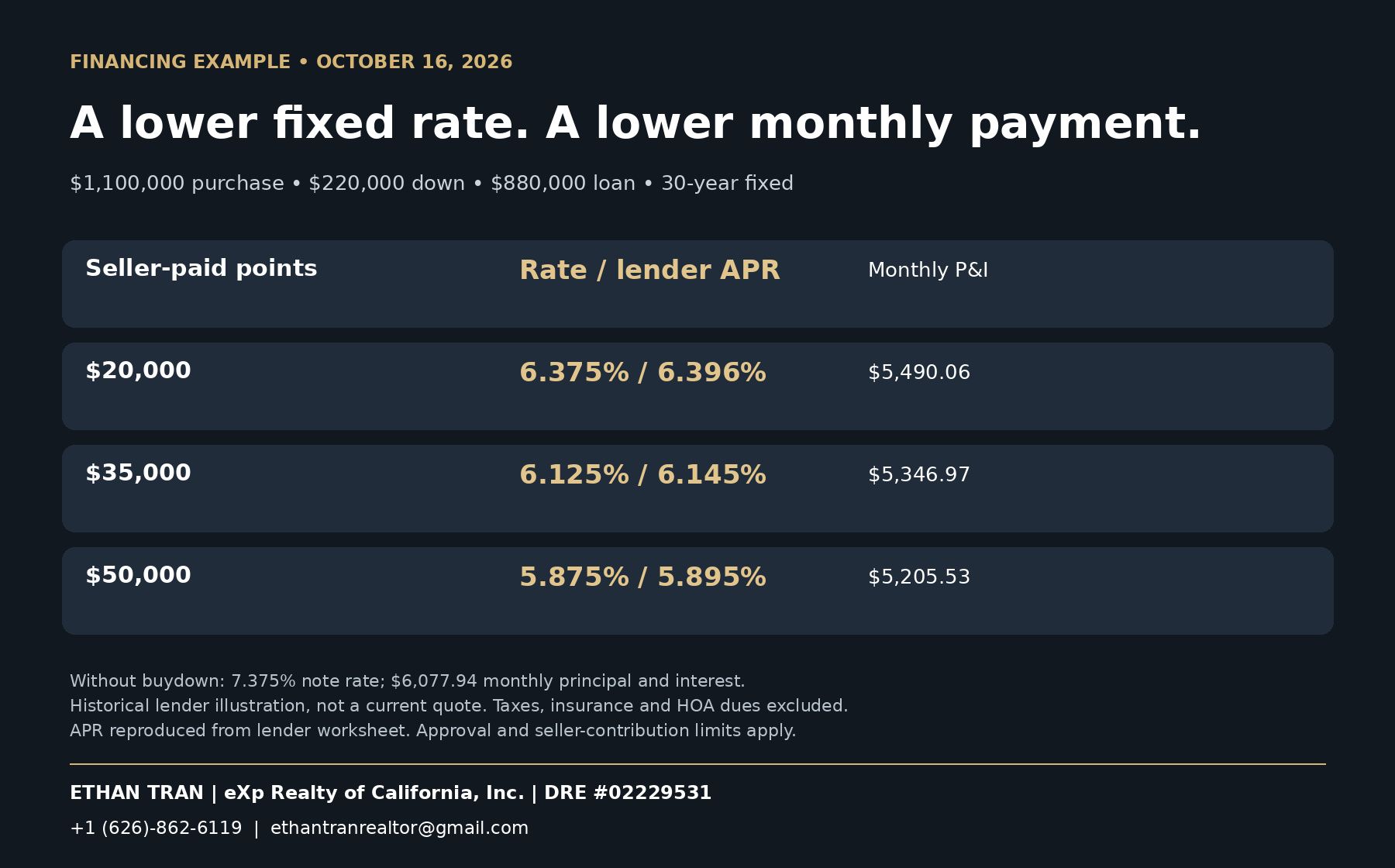 A permanent buydown: reducing the fixed interest rate
A permanent buydown uses upfront discount points to obtain a lower interest rate. When a seller agrees to fund eligible points, the buyer can receive a lower rate without personally covering that portion of the closing costs. The seller still bears that cost, and the credit must fit the loan program's contribution limits.
Here is the lender's example: a $1,100,000 purchase, $220,000 down payment, and $880,000 loan on a 30-year fixed term. The baseline illustration uses a 7.375% note rate and a $6,077.94 monthly principal-and-interest payment.
| Seller-paid points | Fixed interest rate | Lender-listed APR | Monthly principal & interest | Monthly reduction |
| $20,000 | 6.375% | 6.396% | $5,490.06 | $587.88 |
| $35,000 | 6.125% | 6.145% | $5,346.97 | $730.97 |
| $50,000 | 5.875% | 5.895% | $5,205.53 | $872.41 |
In the last scenario, that is $10,468.92 less in principal-and-interest payments during the first year than the baseline example.

These are different pricing options for the same illustrated loan, not a promise that every seller will agree to a credit or every buyer will qualify. The worksheets list APRs based on $1,900 in lender fees and no prepaid interest; ask the lender for a complete, borrower-specific Loan Estimate and APR calculation before relying on them. Taxes, insurance, HOA dues, and any applicable mortgage insurance are additional.
My role is to help negotiate the purchase terms and coordinate with your lender. Before asking for a seller credit, I want to understand how it compares with a price reduction or help with other closing costs. The best use of a credit depends on your cash needs and how long you expect to keep the loan.
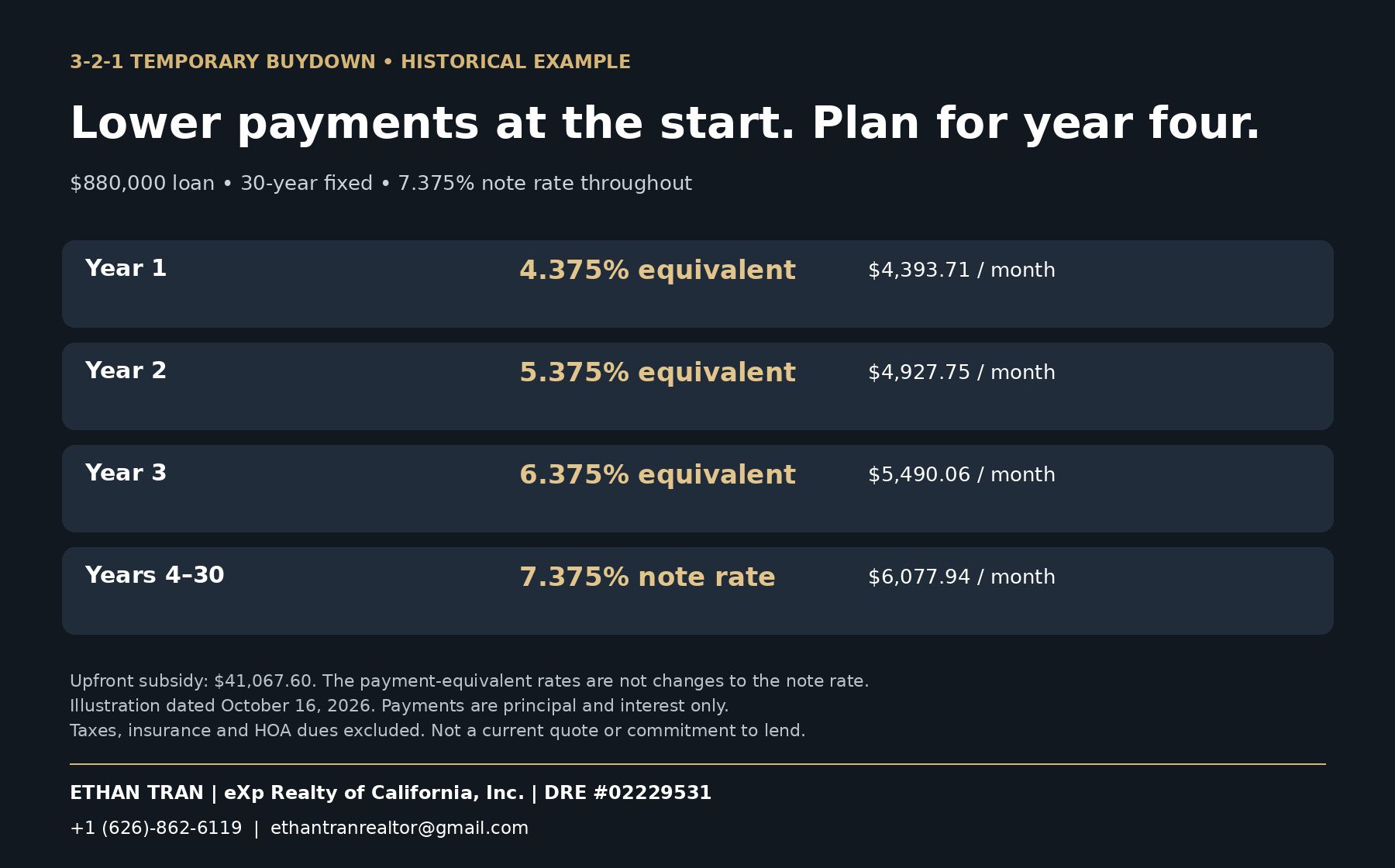 A temporary buydown: lower payments for a limited time
A temporary buydown works differently. Money is set aside upfront to subsidize part of the payment during an initial period. In these examples, the underlying fixed note rate remains 7.375%.
The lender's 3-2-1 example uses the same $880,000, 30-year loan:
| Payment period | Payment-equivalent rate used in illustration | Buyer's monthly principal & interest |
| Year 1 | 4.375% | $4,393.71 |
| Year 2 | 5.375% | $4,927.75 |
| Year 3 | 6.375% | $5,490.06 |
| Years 4–30 | 7.375% note rate | $6,077.94 |
The upfront subsidy totals $41,067.60. In year one, the buyer contributes $1,684.23 less per month than the full principal-and-interest payment, with the subsidy covering the difference.
The lender also illustrated a 2-1 buydown, with $4,927.75 monthly principal and interest in year one, $5,490.06 in year two, and $6,077.94 beginning in year three. Its subsidy totals $20,856.84. A 1-0 buydown starts at $5,490.06 for the first year before reaching $6,077.94 in year two, with a $7,054.56 subsidy.

The key is to budget for the full payment from the beginning. Alternatively, it is possible to get your realtor to negotiate to have the seller pay for your buydown. A temporary subsidy ends on schedule whether or not refinancing becomes attractive. For Fannie Mae loans, qualification is based on the note rate rather than the temporarily reduced payment; the lender must confirm the rules for the actual program.
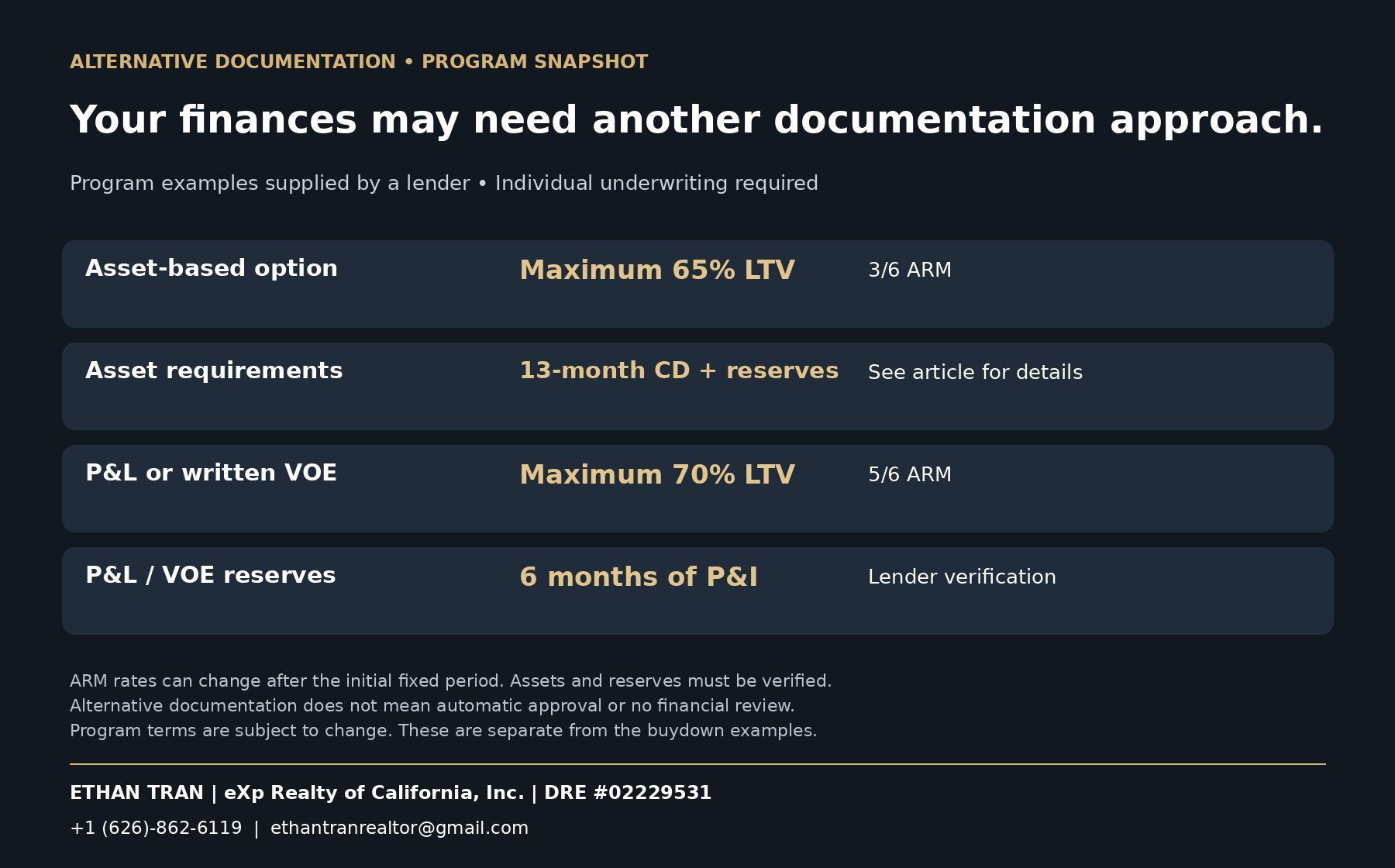
Non-QM and alternative documentation: another way to evaluate the borrower
Payment size and loan qualification are two different challenges.
Non-QM means a loan does not meet the Qualified Mortgage criteria. Some programs use alternative ways to document a borrower's finances. Alternative documentation alone, however, does not establish a loan's QM status; that classification should be confirmed by the lender.
These options can be relevant when a traditional paperwork process does not fully capture a borrower's financial picture. They still involve underwriting. For most consumer mortgages covered by the ability-to-repay rule, lenders must make a reasonable, good-faith determination that the borrower can repay.
The lender shared two separate program examples:
• Asset-based option: Up to 65% loan-to-value, with a 3/6 adjustable-rate mortgage. The flyer specifies a 13-month certificate of deposit funded with 12 months of principal and interest, plus 12 months of principal-and-interest reserves. The lender needs to confirm eligible assets, how the CD is held, and how these requirements interact. The rate is initially fixed for three years and then adjusts every six months.
• Profit-and-loss statement or written verification of employment: Up to 70% loan-to-value, using either a P&L statement or written VOE, with six months of principal-and-interest reserves. This example uses a 5/6 ARM: initially fixed for five years, then adjusting every six months.

For a purchase, those maximum LTVs generally mean at least 35% or 30% down, respectively, before closing costs and required reserves, assuming the appraised value supports the price. Both flyers list 2/1/5 adjustment caps. The lender should explain the index, margin, floor, caps and possible future payments.
The alternative-documentation flyers do not provide complete APRs or dated, borrower-specific quotes, so I have not presented their advertised rates as available offers here. These programs are also separate from the fixed-rate buydown examples above; combining features would require specific lender approval.
California buyers: look beyond principal and interest
Whether you are buying in Los Angeles, Irvine, Anaheim, Riverside, or Rancho Cucamonga, the payment examples above are only one part of the budget.
A California purchase generally triggers reassessment to current market value unless an exclusion applies. The seller's existing tax bill may therefore be a poor guide to your future taxes. Ask for an estimate based on your purchase and the property's actual local charges.
A change in ownership can also generate one or two supplemental property tax bills, separate from the regular annual bill. California's Board of Equalization explains that supplemental bills go directly to the owner, even when regular property taxes are paid through a mortgage impound account. Confirm who will pay them instead of assuming they are covered.
Review the property's tax bill for Mello-Roos special taxes and other assessments, where applicable. Orange County's Treasurer-Tax Collector identifies Mello-Roos charges under the Special Assessment Charges section. Check the actual property rather than assuming every neighborhood has the same costs.
Also get a property-specific homeowners insurance quote and account for HOA dues and any applicable mortgage insurance. A lower principal-and-interest payment helps only if the complete housing cost fits your budget.
Start with a comparison you can understand
Before deciding that buying is out of reach, ask for a clear comparison of the options that actually fit your finances: upfront cash, total monthly housing costs, documentation requirements, and future payment changes.
Sometimes the right move is a seller-funded permanent buydown. Sometimes temporary relief helps with the transition. Sometimes another documentation method is worth exploring. And sometimes the numbers still say to wait.
My job is to help you understand those choices and negotiate a purchase that supports your goals. Your lender determines eligibility and provides the loan terms.
Want to review your options in Los Angeles, the Inland Empire, or Orange County? Contact Ethan Tran.
Ethan Tran | The Tran Team | eXp Realty of California, Inc.
Phone: +1 (626)-862-6119
Email: ethantranrealtor@gmail.com
California DRE #02229531
*Educational examples only; not a loan offer or commitment to lend. All real-life examples provided courtesy of Kelly Chao with ACG Funding. Rates, fees, availability, and approval depend on lender guidelines and the borrower and property. Buydown figures are historical lender illustrations dated October 16, 2026. Payments shown are principal and interest only. Seller credits require agreement and are subject to program limits. ARM rates and payments may change after the initial fixed period.*
Categories
Recent Posts